Science of Climate Change
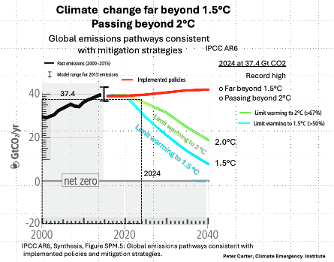
The all- important single fact of climate change science is from the 2022 IPCC Sixth Assessment (AR6)
For 1.5°C AND 2°C global emissions decline by 2025 IPCC AR6 (IPCC Chair).
Climate change is actually Climate System Change, that takes in the entire biospshere
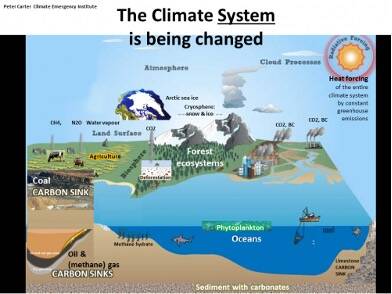
Oceans
The largest component by far is the oceans, which ultimately determine the climate and climate change.
GHG emissions cause damaging ocean heating, acidification and deoxygenation.
Inertia
The climate system is characterized by enormous inertia, which implies enormous momentum.
Slowing climate change is like slowing the Titanic.
One example of inertia is that global warming will last over a thousand years, as will ocean heat, sea level rise.
Lag times
Due to ocean heat inertia, there is a lag from global warming emissions to global temperature effect.
Most of the temperature increase happens in 10 years, after which it takes hundreds of years for the full effect.
Long lag for policy
The IPCC AR6 says following a best-case powerful mitigation it takes 20-30 years for the global temperature to respond
Inertias contribute to committed future higher degrees of climate change (commitment to more warming)
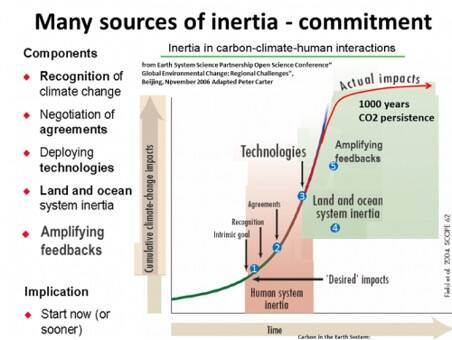
For policy making it is essential to apply committed warming- not today's warming in estimating mitigation.
The science makes it clear that constantly increasing atmospheric CO2 and other greenhouse gas emissions is inherently catastrophically dangerous to all future life (land and oceans), due to enormous sources of amplifying feedback.
Fossil Fuels The environmental health issue of fossil fuels is toxic air pollution as well as atmospheric GHG pollution.
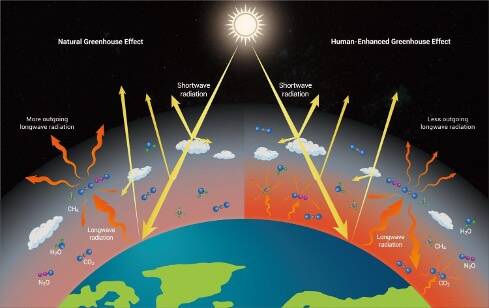
Global warming is actually global surface heating- heat energy is being added to the lower atmosphere, by GHGs. The heating is from the enhanced greenhouse effect.
The basic science is the greenhouse effect and the enhanced greenhouse effect, of global warming
The greenhouse effect and the enhanced greenhouse effect, of global warming.
Global surface warming is what happens when increased GHGs trap increasing heat energy in the lower atmosphere.
Increased atmospheric GHGs actually heat the global climate system. Most of the heat (90%)goes straight to the oceans, with global surface warming only a relatively small amount that gets released from the oceans.
Climate sensitivity
How sensitive the climate is, of course is crucial. It is greatly underestimated.
It is defined as the increase in global temperature that results from a doubling of atmospheric CO2, which is a single fixed metric used in models to project future global warming, and results in a linear increase in warming. That's a problem, because under continued emissions and higher warming, global warming does not increase in a linear fashion. This is a fundamental fatal flaw that has led to a greatly underestimated sensitivity
It ignores amplifying feedbacks and carbon sink weakening with rising surface temperatures. These are called slow feedbacks, which if included doubles climate sensitivity after mid-century. From the first 1990 assessment to the last in 2022, the IPCC has put the climate sensitivity at 3°C. However, the IPCC models put it at 3.8°C, and this ignores the fact that it is 'likely' up to 4.5°C (IPCC). James and colleagues in a published paper put it at 4.5°C (Nov. 2023).
The sources of the greenhouse emissions.
Sources fall into two main general categories- industrial age energy production and food production.
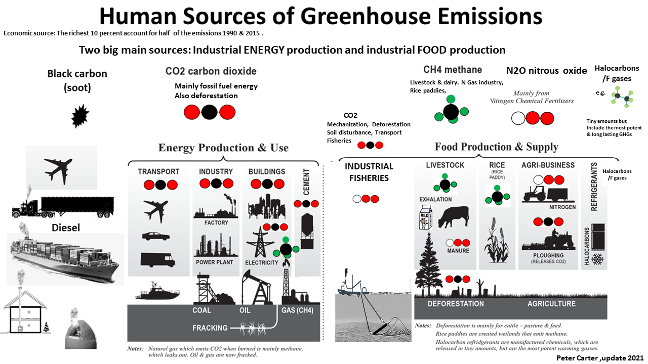
Aspects of greenhouse gas emissions
o GHG emissions cause global warming – global average increase in the surface temperature.
o Global radiative forcing (heating) is the net heat energy added to the planet.
It is the best indicator of global change, as it increases steadily, and indicates future warming as well the present.
o Global warming cases climate change
o GHG emissions add heat AND energy to the lower atmosphere, warming & energizing it.
o Global warming increases water vapor in the air, which has the largest greenhouse effect due its great atmospheric abundance.
o Increased energy and water vapor lead to torrential rains and floods
o Atmospheric GHGs are trace gases in tiny amounts - so very powerful greenhouse warming agents.
o GHGs (re) Radiate heat from the Earth in the lower atmosphere, warming the surface of the Earth
o They are long lasting (in the atmosphere) - especially CO2 and nitrous oxide (N2O)
o A large proportion of CO2 lasts 1000 years, on average CO2 emissions last about 200 years (CDIAC)
o CO2 emissions are persistent (in the atmosphere and hence
o Cumulative - a constant addition of long lasting CO2 will build up rapidly, increasing the atmospheric CO2 concentration
o GHG emissions are constantly produced by fossil fuel energized industrial manufacturing and services
o Emissions and all of their effects are increasing abruptly in terms of geological time and in terms of the existence of humans.
The Planet’s thermostat
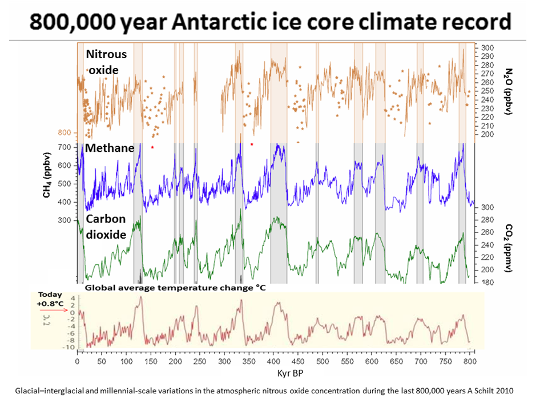
The three main greenhouse gases are naturally produced by planet Earth and are the planet's thermostat, swinging the climate in and out of ice ages and warm interglacials, CO2 being the main thermostat. This shows they are very powerful.
Trace gases
We also know they are very powerful because they are 'trace' gases existing in tiny atmospheric concentrations of parts per million for CO2 (ppm) and parts per billion (ppb) for methane and nitrous oxide.
Without atmospheric GHGs the Earth's surface would be frozen, 30 °C cooler than today.
This is recorded in the ice cores
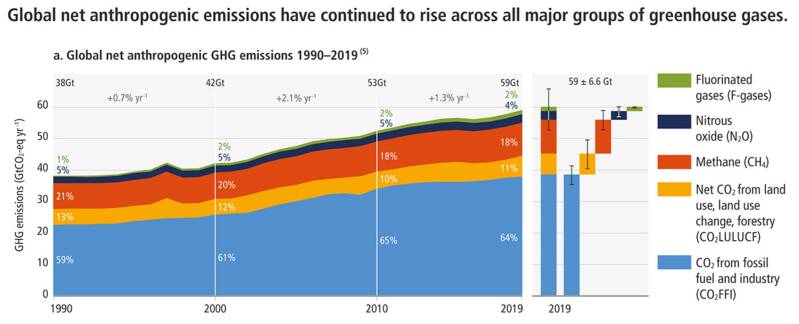
The IPCC AR6 shows the emissions have been increasing for all and each of the GHGs, and continue as fast as ever.
Aspects of greenhouse gases, by their science
Each greenhouse gas has a particular quality that increases the danger of its emission.
CO2 Carbon dioxide is regarded as lasting in the atmosphere for 100 years. However, it is extremely persistent because 20% of emissions last in the atmosphere for 1000 (one thousand) years. Its main source is fossil fuels, next is deforestation.
CO2 emissions have caused about two-thirds of global heating, but the IPCC says this is now closer to 80%. CO2 emissions cause all of the ocean acidification. Fossil fuels contribute 90% of global CO2 emissions.
Methane CH4 lasts in the atmosphere for 12 years, but the emissions of methane carry on global warming longer than 12 years. This is because methane disappears over 12 years because it is converted to other greenhouse gases, notably water vapor and carbon dioxide.
Methane is an very potent global warming gas. Its global warming effect (global warming potential) is 100 times that of carbon dioxide for 10 years after emission and 70 times that of carbon dioxide for 20 years after its emission.
Another dangerous aspect of methane emission, which is unique to methane, is that the more methane is poured into the atmosphere the longer subsequent emissions last in the atmosphere.
Nitrous oxide N2O is extremely persistent in the atmosphere lasting at least 100 years. Over this period of time its global warming effect is 300 times that of carbon dioxide. It is now the top stratospheric ozone depleter.
These are the three main global warming greenhouse gases being constantly emitted.
Industrial civilization is a source of other greenhouse gases too (shown on the IPCC emissions image).
F-gases (halocarbons) include the most potent global warming and the longest lasting of all greenhouse gases, and though in small concentrations they are increasing the fastest.
Surface ozone. Ground level (tropospheric) ozone. Ground level ozone is a result of fossil fuel ambient air pollution. It is formed by a chemical reaction in the air catalyzed by ambient heat and sunlight, and therefore its concentration increases with global warming. It is toxic to plant health as well as to human health. As a result, the increased concentration of ground-level ozone with global warming will damage agricultural crops. It will also reduce the capacity of planetary vegetation to take up carbon dioxide from the air, and this is projected to constitute a significant carbon feedback (by which global warming gives rise to more warming).
Microplastics
A new emission is the worst of all.
Microplastics are ubiquitous and science has recently discovered that they have properties that increase global warming
They are a fossil fuel product - petrochemical
Effects of GHG emissions
The effects of GHG emissions on the planet and life on Earth are multiple and profound

Climate Change Indicators
Multiple direct causes and effects of emissions are monitored, monthly and annually, and recorded by climate science. These are provided by NOAA, NASA, Berkeley Earth, Copernicus and WMO.
An annual indicator update from these monitoring centers is now provided by Forster et al. Indicators of Global Climate Change 2025: annual update of key indicators of the state of the climate system and human influence.
This includes the main indicators of global heating, radiative forcing and Earth Energy Imbalance (the gold standard)
All indicators are record high, increasing as fast as ever, some faster. In particular, global warming is accelerating
Atmospheric CO2 continues to increase at an accelerating rate.
The Global Carbon Project provides annual data on CO2 emissions, and on methane and nitrous oxide emissions ever few years.
UNEP provides an annual Gap Report on global emissions.
FOSSIL FUELS
There are many climate change affecting emissions from fossil fuels
It is important to appreciate that fossil fuels are burned for energy the world over, CONSTANTLY.
Fossil fuels are the dominant driver of global warming, responsible for over (75%) of all human-caused greenhouse gas emissions and nearly (90%) of global carbon dioxide emissions.
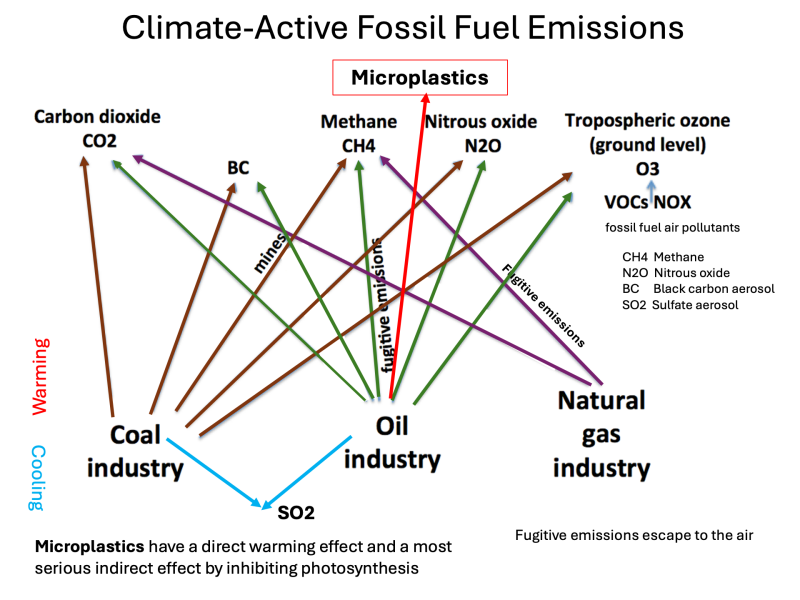
This crucial because net zero CO2 emissions is impossible without zero fossil fuel combustion, and in fact zero carbon combustion. These are readily achievable. EMISSIONS Fossil fuel combustion results in emissions of CO2, methane, nitrous oxide, surface ozone, air pollution warming black carbon aerosol (soot) and air pollution cooling acid (sulfate) aerosols.
Surface ozone/ground level (O3)
Surface ozone is an indirect fossil fuel source of warming. It is formed by a chemical reaction of ambient fossil fuel chemical pollutants, catalyzed by ambient warming sunlight. It is a very short-lived greenhouse gas with a significant warming effect. Because its formation is catalyzed by ambient warmth, global warming increases atmospheric ozone, a feedback process. More warming means more surface ozone. Ground-level ozone is a highly toxic air pollutant on the respiratory tract. It is also toxic to green plants and, therefore to crops, making it one of the climate change adverse effects on crop yields.
Microplastic pollution
The new global warming emission that we have become aware of is potentially the very worst of all, and this is the emissions into into the air of microplastics. Microplastics and also nano plastics are ubiquitous and the plastic production from the petrochemical industry is increasing. The only way to stop the plastic pollution is to phase out fossil fuels fast.
Recent research finds that coloured microplastic particles in the air have a direct global warming effect. Potentially far worse is the indirect effect microplastics inhibiting the photosynthesis of green plants on which all life depends. It is thus an even more definite a survival imperative to phase out fossil fuels fast.
COOLING fossil fuel air pollution acid aerosols (minute particles suspended in the air)
Cooling aerosols have taken on a big new importance. Over the past decades, these cooling fossil fuel emissions have offset much of the CO@ warming emissions. From 2006 China has been improving its air quality, which has reduced air pollution and reduced these cooling aerosols, 'unmasking the hidden warming'. Less cooling aerosols have added more warming, which has accelerated global warming faster. This 'unmasking of hidden heat' was anticipated years ago. It has also been called global dimming.
FEEDBACKS
Climate change science is all about feedbacks.
Dangerous climate change is all about +ve amplifying feedbacks.
There are fast-reacting feedbacks and slow-reacting feedbacks.
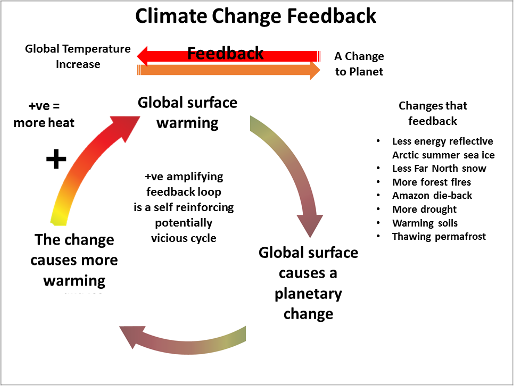
The very worst effect of global surface warming is the multiple enormous planetary sources of amplifying feedback (to global warming), which inevitably add to global warming under continued emissions.
The feedback process is that global surface warming causes a major change to certain aspects of the planet surface, which adds to global warming. Global warming causes more warming.
The GHG feedback results in a feedback loop, which is self-reinforcing, by repeating itself.
If emissions are continued, this leads to uncontrollable global heating-climate change runaway.
Catastrophic climate system danger
The greatest global warming danger of all- is all the many 'positive' amplifying feedbacks, with feedback loops.
Forcing (heating up) the climate system is inherently catastrophically dangerous because of this.
It is multiple amplifying feedbacks that can lead to uncontrollable Hothouse Earth and global climate change runaway.
Most feedback sources are Arctic and they are enormous. For example, permafrost holds double the atmospheric carbon.
CARBON SINKS
Are actually carbon stores, because the land and ocean uptake of CO2 is not permanent in any sense, due to the carbon cycle.
The only permanent sinks take millions of years to sink CO2, as fossil carbon.
It has been known for years that over the long term, the sinks become weaker, absorbing progressively less carbon.
From Global Carbon Project 2025 Report, the sinks reduce our emissions by a huge 50%. Land (forests) 21% and Oceans 29%.
The report has 2025 global CO2 emissions and atmospheric CO2 concentration at record high
The carbon sinks are weakening, which means more of our CO2 emissions will remain in the atmosphere, boosting today's accelerating atmospheric CO2 increase.
From the Report, "on average for the 2015-2024 period, the land and ocean CO2 sink are respectively 25% and 7% smaller than what they would have been without the effects of climate change and variability". This weakening has increased every year for the past 5 years (annual Global Carbon Project Report).
Create Your Own Website With Webador