Children
Climate change is/should be all about all the world's children
The science of climate change tells us about the future of the children in our lives.
There is no question that for our children, climate change is the most dire emergency.
The climate system is characterized by huge inertia and momentum, which means there is far more climate change locked in or 'in the pipe, ' as James Hansen puts it. That means more and worse extreme weather events, which the IPCC 6th Assessment states are being increased by human climate change, and which will get worse so long as the world keeps burning fossil fuels. That's why climate change is all about today's children.
Incredibly, in the IPCC 6th Assessment (AR6) report for policy, there's ony two mentions of children, though I did find a separate short essay on the issue, seemingly as an afterthought.
As global emissions keep being increased, and governments still subsidizing the fossil fuel industry, today's children are being knowingly left with a worsening future. Today's children are the first generation born into a climate changed (disrupted) Earth)
Small children are the most vulnerable to all climate change impacts
1. At present and 2. Throughout their lives
CHILDREN ARE MOST VULNERABLE TO ALL IMPACTS OF CLIMATE CHANGE
The IPCC AR6 Synthesis Headline Statements includes: 'There is a rapidly closing window of opportunity to secure a liveable and sustainable future for all'. That's for the etire lifetime of all the worlds chil
2023 UN: Urgent action by States is needed to tackle climate change, says UN Committee in guidance on children’s rights and environment. This statement encompasses their rights to information, participation, and access to justice to ensure that they will be protected from and receive remedies for the harms caused by environmental degradation and climate change.” (UN Office of Human Rights, 28 August 2023). That's too true, but it is not happening
The climate crisis poses an “existential risk” to the health and wellbeing of all children and action to tackle it is needed immediately Britain’s most senior paediatrician Dr Camilla Kingdon (The Guardian, 21 Oct. 2023).
Climate Change & Global Child Health 'climate change transcends geopolitical boundaries and will have extensive impacts on child health and security. With implications for all of humanity, climate change will disproportionately affect children.
Oct. 2023, Children are at ‘an existential risk’ from the climate crisis, UK’s top pediatrician h.
IPCC 2022 6th Assessment question
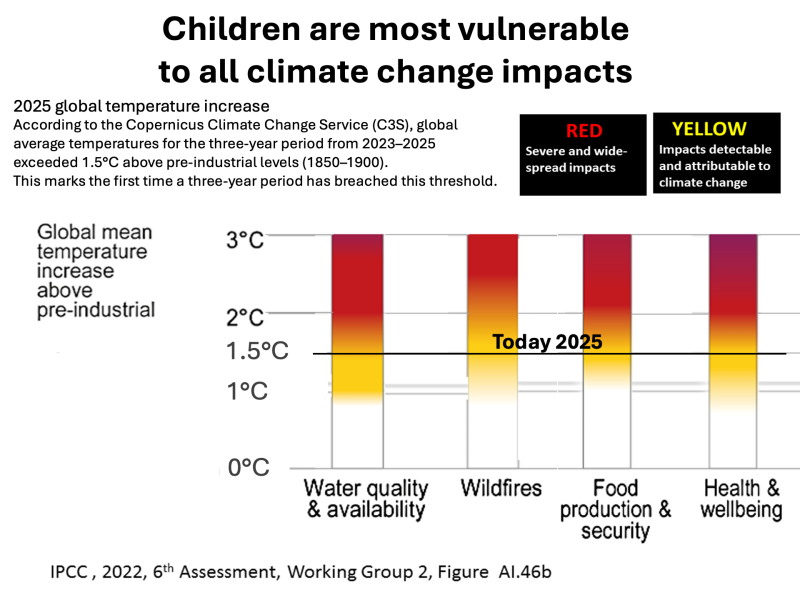
How will climate change affect the lives of today’s children tomorrow, if no immediate action is taken? Extract: 'Climate Climate change impacts are increasingly being felt in all regions of the world with growing challenges for water availability, food production and the livelihoods of millions of people. We also know that impacts will continue to increase if drastic cuts in greenhouse gas emissions are further delayed – affecting the lives of today’s children tomorrow and those of their children much more than ours'.
UNICEF
“We call on all members of society to join us in a global movement that will help build a world fit for children through upholding our commitments to the following principles and objectives…
“Protect the Earth for children. We must safeguard our natural environment, with its diversity of life, its beauty and its resources, all of which enhance the quality of life, for present and future generations. ( A World Fit for Children, 2002, UN Special Session on Children, 2002)
1.5 to Stay Alive
Under the 2015 UN Paris Agreement, nations committed to the 1.5°C global warming safety limit, which is now the limit adopted
by climate science, and all parties involved. However, by 2024, a record temperature increase, 1.5 °C was impossible.
The IPCC AR6 (2022) made it clear that an immediate, rapid global emissions decline is required to limit warming to 2°C as well as 1.5°C (long gone)
Children in industrially developed countries as well
Quite rightly all reports stress that the most vulnerable children live in under industrially developed regions where the population is poorest and least to blame for climate change.
However, the children of the poorest families everywhere are more vulnerable. Even in the most advantaged developed countries, we have already seen how children are most vulnerable to extreme weather disasters, like heat waves and floods.
The IPCC predicts this and other impacts affecting children will increase. Children in all regions are most vulnerable to extreme weather events.
Throughout the 21st century climate-change impacts are projected to:
> slow down economic growth,
> make poverty reduction more difficult,
> further erode food security, and > prolong existing and create new poverty traps
This is all happening
Impacts from recent climate-related extremes, such as heat waves, droughts, floods, cyclones, and wildfires, reveal significant vulnerability and exposure of many human systems to current climate variability (IPCC AR6).
Impacts of such climate-related extremes include alteration of ecosystems, disruption of food production and water supply, damage to infrastructure and settlements, morbidity and mortality, and consequences for mental health and human well-being', which have affected 'countries at all levels of development. (IPCC AR6)
Food production
At already committed degrees of climate change all major food producing regions will suffer crop yield declines with food shortages to which developing children are most vulnerable.
'Based on many studies covering a wide range of regions and crops, negative impacts of climate change on crop yields have been more common than positive impacts' (IPCC AR6, 12.5 )
Diseases
Communicable diseases have already started to spread from tropical regions to the more wealthy temperate regions, and new diseases are predicted. In the future, this will affect all countries.
Displacement
Climate change is already increasing the number of refugees, with children most at risk.
Conflict
Climate change-driven conflict (a cause of refugees) as long predicted, is happening and in the future can affect most countries.
Climate change can indirectly increase risks of violent conflicts in the form of civil war and inter-group violence by amplifying well-documented drivers of these conflicts such as poverty and economic shocks. Multiple lines of evidence relate climate variability to these forms of conflict (IPCC AR6).
Air pollution from fossil fuel emissions
Today 8 to 10 million people die from air pollution, and global warming makes aie pollution worse.
Millions of children already die from preventable disorders
The world has made substantial progress in reducing child mortality in the past several decades. Even so every year, millions of children under 5 years of age die, mostly from pneumonia, diarrhea, and malaria. In almost half of the cases, malnutrition plays a role, with unsafe water a significant factor. Climate change increases all these.
World Fit for Children Statement
“We call on all members of society to join us in a global movement that will help build a world fit for children through upholding our commitments to the following principles and objectives…
“Protect the Earth for children. We must safeguard our natural environment, with its diversity of life, its beauty and its resources, all of which enhance the quality of life, for present and future generations".
( A World Fit for Children, 2002, UN Special Session on Children, 2002)
January 2025, Planetary Insolvency Actuaries' expert risk assessment on Climate Change and Mortality, includes children
Planetary insolvency threatens children’s futures by breaking down essential life-support systems (water, food, stable climate), potentially causing societal instability and financial collapse. Reports warn that unchecked climate change and ecological damage, if not mitigated, will create severe, potentially catastrophic living conditions for future generations, far exceeding current risk models.
Create Your Own Website With Webador